Showing posts with label crochet. Show all posts

Saturday, 11 March 2017

It turned out alright in the end

I started work on this shawl collared waistcoat back in November, based on a pattern from "Custom Crochet Sweaters (Dora Ohrenstein)". It was not overly complicated but had the novelty factor of being worked vertically with increases based on changing the stitch height.

Everything started well and I made good progress, but misunderstood the increase instructions and didn't notice until I had almost finished. I wouldn't have been happy with the finished result, so I ripped the whole garment out and remade it, finally placing the last stitch on Christmas Eve. By this point I had lost the love entirely so put it aside, only taking it out last month to reluctantly sew it together.

I'm glad I persevered though as I think it turned out well.
Shawl collared waistcoat.
 Worked up in Wendy Mode DK on a 5.5mm hook I had to rework the pattern a fair bit as usual, I couldn't make gauge, this is why I got lost on the increases. My interpretation of the word 'repeat' and whether it includes the original instruction on what to repeat, differed from the designers intended meaning. As I had to adjust most of the stitch and row counts, it is easy to see how I got confused.
Stitch pattern.
The stitch pattern combined dc and tr in a cluster, reminding me of my favourite baby blanket. It was easy to memorise and works up quickly, which is why I was able to make this whole garment twice in under two months. The only delay was I couldn't face sewing it together.
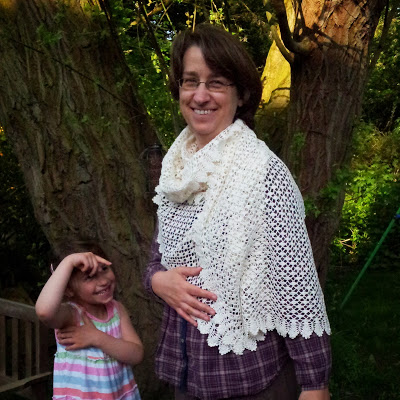
Me.
I fastened the front with a single snap as recommended by the pattern. The stitches had to be stabilised, by darning into the clusters to produce a firmer fabric before sewing the snap on. The only real issue with the design is the curl on the bottom of the front pieces. I tried steaming the area before making up which helped a little but didn't completely eliminate the problem. As Wendy Mode is 50/50 Merino Wool/Acrylic I didn't want to do more for fear of killing the yarn.

So in summary, this should have been a quick and easy made which was complicated because I couldn't hit gauge so had to rework all the numbers. It was however completely worth the effort as it is a lovely waistcoat and has already made it into regular circulation as part of my wardrobe.

Thursday, 4 August 2016

A phone cosy

A few weeks ago, after nearly four years of loyal service my mobile phone died. It was particularly annoying because as far as I could tell, the problem was a software one to do with the Android OS rather than anything hardware related. In the end, I had to remove a key piece of Android software and because it would silently reinstall every time the phone connected to the internet, it became useful for voice calls and text only.

Reluctantly I bought a new phone, which naturally needed a new case to protect it while in my bag.

Rather than buy a cheap plastic case, I decided to make one and chose some left over Peaches & Creme cotton to do so.

After looking through my stitch dictionaries and crocheting a few swatches, I decided I'd try alternate 'shallow crochet'.

Shallow crochet stitches are spiked double crochet, i.e. worked into the top of the stitch on the row below the current working row. I wanted to work tightly, but a swatch of pure shallow stitches was too stiff and very hard on the hands. I elected for the alternate stitches instead which produces a firm fabric with vertical stripes of 'V's which look a bit like knitted stitches.

To keep my phone safe from the many things I carry around, I wanted this to be fairly tightly as a piece so decided to work with a 3.5mm hook. I highly recommend a pointy tip, as the shallow stitch is firm, making it difficult to get the hook into.

I worked 30 dc in the round, starting with 15 foundation-dc, then turning and working 15 stitches into the base of the 15 fdc I'd just made.
Alternating shallow crochet stitches.
When I had 30 stitches, I joined with a slip stitch, 2ch, then worked a row of dc, finishing with another slip stitch to join.

After that, I started working alternate shallow dc stitches with normal dc in the round to give the ribbed effect.

It is a bit tricky picking up the loops of the previous row, but following the the strands of the base of the dc you'd normally be working into helps. The shallow stitch will result in a 'V'; in subsequent rows, aim your hook just above the point where the 'V' makes a point. If you look at the back of the work, you should see the hook come out just below the back loop two rows down.

Keep working in the round until the phone is just covered, then finish with a row of dc and then a row of crab stitch (reverse dc). I added a loop fdc half way around one side of the final crab stitch edging.

All finished, with a button added.
After that it was just a case of sewing on a suitable button.
All finished.
Final dimensions for my case were 10cm x 16cm.
Ready to keep my phone safe.

(As always, I am using British crochet terms.)

Saturday, 4 June 2016

One last time

About a week ago, I finished the blue cotton cardigan I started for M back in March. Considering I swatched for this project in February, this means it has taken me over three months to knit a garment to fit a nearly six year old. I really am not a speedy knitter these days. Fortunately, M had asked for a summer cardigan so my timing is impeccable.

After a lot of thought, I decided to make the Sirdar simple cardigan one more time. I've already made this pattern twice before (last year and in 2014), so it was a familiar make. I wanted to make the cardigan in a size bigger than M, so for a 7-8 year old, which presented a challenge as the Sirdar pattern only goes up to 6-7. I was all set to rework the numbers, but started with my swatch and no matter how I tried I could not get my chosen yarn (Drops Muskat) to come out to the specified gauge of 22 stitches x 28 rows in stocking stitch gives a 10cm square.

I had two choices:

3.75mm needles 21st x 28 rows = 10cm
4mm needles 20st x 26 rows = 10cm

I could have tried dropping needle size again, but was worried about drape and ending up with a cotton cardigan which was too stiff.

After working the numbers, I decided to knit this cardigan with 4mm needles. The resulting gauge made the piece a couple of centimeters bigger across the chest, bringing the expected size closer to that needed for an eight year old, which was what I needed.
A finished cardigan.
Having made this cardigan before, I decided to mix things up a bit by adding stranded colour work to the bottom of the body and sleeves. This was a new technique for me and keeping tension even proved tricky, but I was pleased with the effect which was very pretty.
The back view.
I was astonished at how quickly this cardigan ate the Muskat. The pattern predicted seven balls and I'd bought eight. By the time I'd finished the back, I knew I'd be in trouble as I'd gone through nearly three balls! By my estimates, I'd run out of yarn on the second sleeve... So I hastily bought another five balls of the same dyelot, because I wanted enough left over to add to another project. I am so glad I did, as this project used nine balls of the main colour and one ball of the contrast.

The original Sirdar pattern calls for a knitted border, but the first time I made this I found the border wouldn't lie flat and the collar was messy. I much prefer a crochet border, so I decided to do my own thing.
Getting adventurous with the collar.
Stranded knitted colour work, with a spiked treble, eyelet and scallop edging.
M wanted a ribbon and a turquoise scallop to match the turquoise stranded work, I fancied doing some tiny scallops and spiked stitches, so we ended up with all of those things incorporated into the bottom hem, fronts, collar and cuffs. While I enjoy knitting, I'm more confident with crochet and as such I'm happy to experiment. At one point I was afraid I'd overdone it, but after the last stitch was placed, I decided the crochet finish brings the final garment alive. Finally, M chose the button to match during a trip to the local yarn store.
Collar and front.
The end result is a very pretty cardigan. It is deliberately too big, which is why it currently sits more like a jacket, but by this time next year I think it will fit my daughter well. She may even get a third year out of it!
A happy little girl.
M loves it, so everyone is happy.

Thursday, 26 May 2016

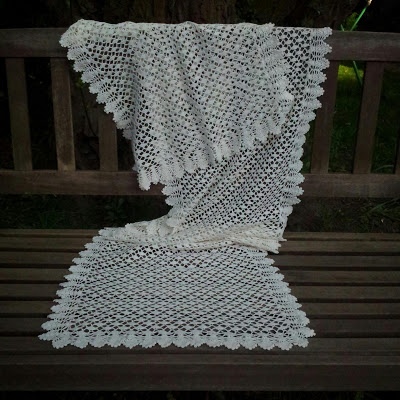
Simply lace shawl

I finished this shawl over 18 months ago, put aside to block and completely forgot about it. I finally remembered it a couple of weeks ago, meaning I've been sat trying to remember what I did! Mostly this means studying the shawl, thinking back and being quietly amazed that something I made is this pretty.
Finished shawl. Isn't it pretty?
I started this shawl back in August 2013. It was intended as a long term travelling project which I could work on wherever I was, picking it up and putting it down as necessary. These days, time for craft is limited to random snatched moments around everything else, which has drastically impacted on my ability to actually make stuff, remember stitch patterns, maintain even tension or keep things from unravelling.
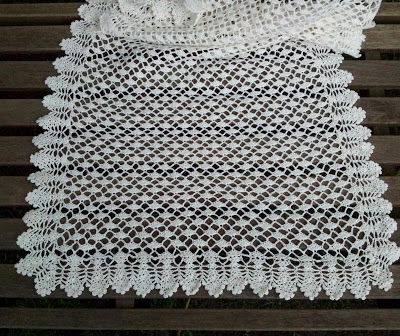
The main panel with its border.
My aim with this project, initially at least, was to make something that wouldn't matter if it wasn't finished. I wanted something to carry around, that would keep my hands busy, wouldn't require me to look at it or pay particular attention to what I was doing and would pack down small.

Lace might seem like an odd choice for this category of project, but if you choose a well behaved cotton thread and keep it clean (which for me meant the project lived in a plastic zip lock bag, inside a cotton bag), it is no different to working anything else. Cotton thread is thin but strong, the hook is tiny and the stitches are teeny but will open up on blocking to reveal their beauty.

I started off by deciding to use stash thread left over from another project. I  planned to make a rectangular panel and put a border on it. My thought was to keep going with the rectangle until it was big enough or I ran out of thread. At that point, I’d put either a border or end panels on, using a contrasting thread if the original thread ran out.

I didn't run out of thread, although there was a horrible moment, one row from finishing the border when I thought I was in danger of doing so! Fortunately, I managed to get that row made, otherwise I suspect this shawl would still be sitting in my working heap.
Overall this was an easy crochet. The repeat pattern was both simple to remember and intuitive to follow. The thread was well behaved and travelled well. I worked on it at home, soft-play centres, parks, nature reserves, historical houses and anywhere else that I found myself with a few minutes to spare. There were a few worrisome moments when I lost the teeny tiny hook down the side of the sofa, but otherwise it just kept growing. The main requirement was persistence on my part and the whole thing took approximately fourteen months to complete.
My daughter likes the shawl very much and has asked if I can make her one of her own.
Final Size
Unblocked - 43cm x 186cm
Lightly blocked - 46cm x 233cm
Final size after a light blocking was 233cm.
Yarn
Circulo Clea which is a #10 count sized thread in 100% cotton.

I had some white Clea thread in my stash, leftover from making a gentleman’s nightcap. I’d bought two balls initially, but only used about half a ball on the hat. From past experience, I remembered the Clea to be very soft, but easy to work with. The softness being important as I wanted a wearable shawl, so while I wanted to use a cotton thread I didn’t want something stiff and scratchy in the way of a thread more suited for doilies.

Hook
Worked with a 2mm hook.

My first stop involved flicking through the many stitch dictionaries I own to find a suitable pretty, not complicated stitch pattern, but with enough going on to keep my interest for months and months and months. I eventually settled on a shell trellis from The Harmony Guides:Basic Crochet Stitches.

I swatched with a 2mm, 2.5 and 3mm hook. Each swatch was washed, blocked and tested for softness. Eventually I settled on the 2mm hook as giving the best result with this thread.

Tension
I didn’t measure gauge or tension, I simply started with the correct multiple of stitches for my pattern and increased until I thought the shawl would be wide enough. The swatches indicated that the finished piece would be be stable in terms of width, only growing a little under blocking but I could expect considerable increase in length as the pattern opened up.

Foundation Row
I personally hate using chain foundations unless absolutely necessary. I find them fiddly, difficult to work the first row into and they can come out at a different tension to the rest of the piece, leading to either puckering or bowing. My preference is for the chainless foundation (or fdc using British notation) which works one stitch at a time, extending the row by placing a single chain in the previous stitch to act as a base for the new stitch. So much easier!

In this case, to support the shell and trellis, I started with a multiple of 12+1 stitches of fdc.

Main Panel
The main panel has a basic shell and chain trellis stitch, taken from one of the Harmony Guides.

This stitch pattern has repeating alternate rows of chain, then 5tr shells with 5ch in between each shell. The shells are worked and anchored at the sides, to the middle chain in the 5ch space of the row below using a dc. I've staggered the shells, rather than stacking them, to give the diamond effect because I thought it was more visually interesting. The chain between the shell rows is anchored with a dc into either the middle ch or tr (as appropriate) of the previous row. I just worked in pattern, putting a half shell (3ch, 2tr) at the beginning/end of the row as needed.

i.e.
Row 1 - 3ch, 2tr into the same stitch to form half a shell. *Skip next 2 fdc from previous row, 1dc into next fdc, work 5ch, skip 5 fdc, 1dc into next fdc, skip 2 fdc, 5tr into next fdc forming next shell, repeat from *. End last repeat with 3tr into the last fdc. Turn.

Row 2 - 1ch, 1dc into first stitch (last tr from previous row). *5ch, 1dc into next 5ch space, 5ch, 1dc into 3rd tr on next 5tr shell, repeat from *. End last repeat with 1dc into the top of the turning chain of the previous row. Turn.

Row 3 - *5ch, 1dc into next 5ch space, 5tr into next dc to form a shell, 1dc into next 5ch space, repeat from *. End last repeat with 2ch, 1tr into last dc, skip turning chain. Turn.

Row 4 - 1ch, 1dc into first stitch (last dc from previous row). *5ch, 1dc into 3rd tr on next 5tr shell,  5ch, 1dc into next 5ch space, repeat from * to end. Turn.

Row 5 - 3ch, 2tr into the same stitch to form half a shell. *1dc into next 5ch space, 5ch, 1dc into next 5ch space, 5tr into next dc forming a 5tr shell, repeat from *. End last repeat with 3tr into the last dc, skip turning chain. Turn.

Repeat rows 2 - 5 until the piece is big enough.

Border
Once the main panel was complete I decided to start on a border. Not having much thread left, I couldn’t make it too elaborate so decided on a simple feather and shell trim. I sketched it out on a piece of paper, stacking 5tr shells which are then extended to widen the ‘feather’ at the top with a picot edge to finish.

I didn’t break the thread, but continued straight from the main panel to the border by reaching the end of  row 5, adding a corner chain, then repeating the 3tr half shell around the corner. Row 5 of the last repeat on the main panel became the start of Row 1 of the border as I was now working in the round.
Close up of a corner.
I would normally work a row of dc around a piece to form a good foundation for any border, but with thread running out I decided against it. The first row of the border starts out very like rows 3 or 5 of the main panel, so I simply placed the 5tr shells and anchoring dcs where it seemed appropriate.

Row 1 - continue straight on from row 5 of the main panel, working in the round and turning the corner by 2ch. 3tr into the same stitch forming another half shell (corner turned). Continue as for Row 5 of the main panel around the sides of the shawl. At the corners, turn with 3tr, 2ch, 3tr in the same stitch. When you reach the beginning of the last row of the main panel, end row with 3tr, 1ch and join to the top of 3rd or top turning chain with 1dc. This last dc will place you in the middle of the equivalent to a 2ch space.

Row 2 - 1ch, 1dc into same 2ch space. 2ch, 5tr into next tr. *2ch, 1dc into 5ch space, 2ch, 5tr into 3rd tr of next shell. Repeat from * to next corner. At corner 5tr into the 3rd tr of the half shell from the previous row, 2ch, dc into 2ch space, 2ch, 5tr into next tr. Corner turned. Continue working pattern between *s, treating each corner in a similar manner. At the end of the row, end with 2ch and ss into the first dc.

Row 3 - 1ch, 1dc in top of joining dc. *2ch, 5tr into 3rd tr of next shell, 2ch, 1dc into next dc, repeat from * until end. Corners should now be set up to be treated as for the rest of the row. At the end of the row, 2ch and ss into first dc.

Row 4 - 1ch, 1dc in top of the same dc, *2ch, 1tr in 2nd tr of next shell, 5tr in next tr (3rd tr of the shell), 1tr in next tr, 2ch, 1dc into next dc, repeat from * until end. At the end of the row, end with 2ch and ss into the first dc.

Row 5 - 1ch, 1dc in top of the same dc, *2ch, skip 1tr, 1tr in each of the next 2 tr, 5tr into the next tr, 1tr in each of the next 2 tr, 2ch, 1dc into the next dc, repeat from * until end. At the end of the row, end with 2ch and ss into the first dc.

Row 6 - Follows on from the pattern laid down in rows 4 and 5, but adds a picot-4 to each alternate tr as it is worked. i.e. 1ch, 1dc in top of the same dc, *2ch, skip 1tr, (1tr, picot-4) into next tr, 1tr in next tr,(1tr, picot-4) into next tr, work 5tr into next tr adding a picot-4 to the 2nd and 4th tr, (1tr, picot-4) into next tr, 1tr in next tr, (1tr, picot-4) into next tr. 2ch, 1dc into next dc. Repeat from * until end.

Join final round with a slip stitch into the first dc, break thread leaving the tail long and pull through.
Blocking.
Block lightly and the weave in the ends before clipping them.

Tuesday, 1 December 2015

A knitting and crochet catch up

It's been a while since I've posted here, mostly down to life getting busy, meaning I just haven't had time to collect my thoughts enough to write. It was only when I popped onto Ravelry to update a project that I realised how lax I've been. Ooops!

I thought I'd do a quick round up of some of the projects I've been working on over the past few months, which means casting my mind back a bit as I try to recall...

I went on a glove knitting drive towards the end of the summer, preparing for winter. I started off with gloves for M, adding to her dwindling supply of pairs that fit with ones that don't fit because they're a bit on the big side. I am currently embracing the she'll grow into it theme when making things for M!
First attempt at gloves.
I'd never made gloves before, so this was a steep learning curve which is why I started with a practice pair, intended for no one in particular. I picked up a book called Gloves by Sussette Palmer, working through the pattern for  'Childs Play' gloves and treating it as a tutorial (link to my Ravelry project) .

As these were for 'playing' purposes, I didn't worry about gauge or fit, concentrating instead on the process of what it was I was trying to achieve, namely learning how to knit fingered gloves. The result is OK, all things considered, but they won't fit anyone in this house, so I may end up passing them on.

The tricky bit with gloves has got to be the fingers, knitting such small tubes and keeping the tension even was difficult. I don't think I got it right and I had issues with ladders between DPNs, something that mystified me because I don't recall having problems the last time I worked in the round. It took me until the ninth finger to find my groove, so I tried again this time with a pair of gloves for M.
Finger gloves for M.
These were made exactly to M's specifications, but I upped the sizing a little so they should fit for a year or two. M loved them. I like them, but wasn't completely satisfied with the thumb. Tricky things, thumbs. My Ravelry project for these is here.

Not to be deterred, I also made M a pair of mittens (here on Ravelry).
Mittens for M.
The mittens were made using the Pretty In Pink pattern from the Gloves book and there were a couple of errors in the pattern. i.e.
  • When working the last row of the frill (R5), the pattern says ”k2tog to the end”. R1 starts on the wrong side, so R5 needs to be purled, hence the instructions should read ”p2tog to the end”.
  • Following the instructions for the thumb gusset will give 15 stitches to save off on waste yarn, not 13 as specified in the pattern. If do you want 13 stitches, increase until there are 11 stitches between your increases. (Personally, I liked the 15 stitches as it gave a nice roomy thumb.)
These definitely are too big. An (albeit small) adult visitor tried them on  and declared they fit her, which gives an idea of how big they are, but I like them and they'll fit ok in a year or two.

So I made another pair of mittens (on Ravelry here)...
Mittens for M.
M liked these ones and the fit is better. Still on the large side, but more wearable I think.

Lesson learned here - I really do need to work on how big, is too big and how big is just a bit of growing room for small people.

Next, I used some left over yarn to make a pair of gloves for me (Ravelry link).
Gloves for Me.
This time, I worked without a pattern and I sized exactly for me. I have long fingers and shop bought ladies gloves are usually too small, so this is the first pair of gloves I've owned that actually fit. I tackled my dislike of the thumb in this pair, offsetting its gusset by 3 stitches, meaning I have a left and right glove.
M said she liked these too, but I insisted they are for Me.
Hopefully, they'll see some good use this winter.

Next up, I tackled socks (here). It has been a long, long time, so I made a pair of bed socks/slippers for me.
Bed socks for Me.
Again, no pattern just me trying to remember what to do and while I'm OK with how these turned out, they are too big. Where there was some rounding up needed for pattern purposes, I went up rather than down which means the sock is much looser on than I'm happy with. They're OK for bed socks, but if I'd intended these for regular wear I'd have been disappointed.
A bit big, but fit for purpose.
Next I went on a hat making binge, making up three nearly identical hats except for the striping pattern.

The first hat was for M (Ravelry link), with the young lady herself choosing the colours and yarn. She also helped me with the striping pattern. I used a 100% wool Sublime Yarns Natural Aran and while it might have purported to be aran weight, it wasn't consistently so. Deliciously soft it might have been, but the yarn went from fat to thin and in some places becoming very skinny indeed, which meant I couldn't hit gauge for the pattern I used (which was Lindsey Carr's Seamless Earflap Hat)
M's new hat for winter.
In the end I picked a hook that worked (5mm), swatched to work out the tension and subsequent gauge, then recalculated everything accordingly. All of which means, I mostly used the pattern to get the proportions right.

M loves this hat, even if again, it is too big for her. She'll grow into it, right?

Finally, we have Blue Bed Socks for M (Ravelry link here).
And finally, bed socks for M.
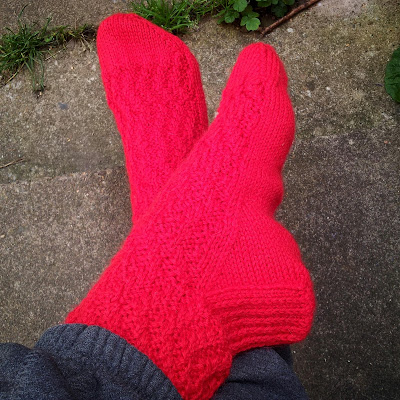
Again, this is my own pattern and are hot off the needles this weekend. I used 4mm DPNs and stash yarn, using a simple 4x2 rib and shifting it either left or right every seventh row. The result was effective and M approves, although she has yet to put them to the test.
Fresh off the needles.
And that about brings us up to date, with the knitting at least!


Saturday, 22 November 2014

A knit for my baby

Back before M arrived, I had plans for my maternity leave which involved a lot of knitting or crochet. I had this vision of me with a new baby all tucked up in her bassinet beside me while I gazed lovingly at her sleeping form, my needles clicking or my hook hooking, as I made up all manner of woolly goodies for her. I planned accordingly, picking up suitable baby yarn and patterns, in readiness for those first few months...

Of course, as is the case with most new mothers, reality turned out to be a little different to my imaginings. I ended up with a baby who was happiest in my arms and I was happy to oblige, which meant my ability to knit or crochet was severely curtailed.

In fact, while I have crocheted intermittently since M’s arrival I had not picked up knitting needles since her birth until earlier this year! My first knitting project was started at M’s request and was Miss Sophie Bear.

My knitting break has left me with a stash of baby patterns and yarns, but instead of a baby I have an independently minded four year old, who has definite opinions on what she will or will not wear. I was determined to knit some of those baby patterns, with some of that yarn so was delighted to discover the Sirdar patterns I’d bought are actually sized from birth to seven years.

While I may be knitting again, I have to sneak it in around the edges of everything else I do, as spare time is practically non-existent these days. This means it takes a comparatively long time to make anything up and I make mistakes as I don’t have time to concentrate properly. I decided that with only three years to go before M outgrew the patterns, I needed to get started knitting straight away.

I chose the simply named ‘Design E - Striped and Plain Cardigan’ from Sirdar’s Little Stars and Stripes, which is a basic cardi with set in sleeves, a ‘V’ neck and fastened by a single button. A little lace adds interest at the cuffs, bottom, fronts and collar.

The yarn I chose from my stash was a pretty pink, self striping special deal from Aldi in a DK weight. Nothing in the way of natural fibres, but soft, cheap and picked up in a haze of hormones a few years back. It knit up nicely on 4mm needles, to the desired gauge of 22 stitches x 28 rows = 4 inch square.

Here is the result, pre-blocking (link to my Ravelry project - here).
Finished cardigan, before blocking - note the curl of the lace edging...
And here, after some steam had been applied.
Finished cardigan after blocking, curl much improved but still sneaking in.
Oh how that lace edging taunted me… It curls horribly at the cuffs and needed some seriously blocking to sort it out, but since I was working with a ‘baby’ yarn (code for acrylic), I was very timid when it came to blocking as it is so easy to over do the steam and kill the fabric. I did steam block this, but not heavily due to the acrylic fibre and although it was improved by blocking, that lace edging still has a slight curl to it, particularly at the sleeve cuffs.
Close up of the lace edging (after blocking).
When it came to the front edges and collar, i decided I didn’t like the suggested border or the way it was worked in two pieces and joined at the back of the neck. I decided to add a crochet edging instead, worked on a 3mm hook as follows:-

  • Lay down a foundation row of dc (repeat of 4 + 1)
  • 5tr shell around, 5dc-ch for the button hole

If I make this cardigan again, I will probably skip the suggested lace altogether and crochet a shell edging instead. I worked the edging (both the suggested lace on the cuffs and bottom, and the crochet edging) in a white baby DK from my stash. This contrasted nicely with the pink self striping.

I added a single lilac button from my button tin, which immediately decided it was a complementary shade of pink once I had sewn it on.

I am very pleased with how this turned out. I haven’t knitted many cardigan’s and due to the long break, this project represented a lot or re-learning old skills. I tried to stick to the pattern, but couldn't resist doing my own thing when the lace edging didn't behave, which was why I substituted with a far more civilised and far less scary crochet edging.
The finished cardigan, modelled by my 'baby'.
M likes the cardigan too. However I have a problem. She took a great deal of interest in how this project developed and has discovered my Ravelry queue which she has now co-opted. Rather than another cardi from my baby knits list, M has insisted my next knitting project should be a cat.

Tuesday, 5 August 2014

Showing restraint

It might not sound significant, but as a baby my daughter was born with a full head of hair, most of which disappeared within a few weeks, leaving her with a few sparse wisps over her adorable little head. This was not a problem. My daughter grew into a hat wearer.
M wearing a hat made by Mummy.

Hair styling has never been my forte. Hair styling, when the hair in question is extremely fine, thin and belongs to someone who cannot stand still for more than a few minutes at a time, has proved a challenge. Like most mothers, I’ve resorted to time honoured methods for keeping my little one’s hair in check. I’ve tried braids, but M doesn’t like to wait as I complete the task. I’ve tried alice bands, but they slip off, rarely staying in place for more than a few minutes. Pigtails were popular for a while, but as M’s hair continued to grow in length but not in body, they turned into lethal weapons on either side of her head. M took great delight in swinging her head from side to side, hair whipping her face with alternate strikes across her cheeks. These days, the mainstay of hair restraint for M is the good old fashioned ponytail. I wanted a child sized hair tie that would stay in place, wasn’t slippery and wasn’t too big because it assumed you had a lot of hair. I made something. This was an experiment. I’ve never made a hair accessory before and couldn’t find anything that was just right on Ravelry, so I improvised. I tied some left over 8 core elastic into a loop, then crocheted over it to give me a base. I then added a simple chain mesh, until it had some substance. And here we have it, a child sized lace scrunchie.

A simple crochet mesh scrunchie.
A simple crochet mesh scrunchie with hair.
This scrunchie is worked in a standard crochet thread (size 10) on a 2mm hook. Guage doesn’t matter in this case, it was more important to use a hook that worked well with the thread.

Method:- I put a foundation row of dc in multiples of 5 stitches around a piece of elastic, covering it. I then worked a 5 stitch chain mesh into this row, as follows. R1 - ch5, skip 4 dc, dc in next dc, repeat until end of round. R2 - ch5, dc in next 5ch space of previous row, ch5, dc in same space, repeat until end of round. R3 - ch5, dc in next 5ch space of previous row; repeat until end of round. R4 - increase in alternate spaces. R5 - as for R3. M likes it. Enough said.

Tuesday, 31 December 2013

Chocolate and Mittens

Christmas seems to have practically flown by this year. M and I did a lot of cooking on Christmas Eve, making chocolate truffles, shortbread festive biscuits, mince pies and jam tarts (for M, who doesn't like mince pies).

I cheated on the pastry, buying pre-made as while M loves making it, she also enjoys handling it and working it a lot, sadly to the point that the pastry becomes impossible to work. I managed to roll the pastry myself, prepared the mincemeat by adding chopped apple to shop bought and M filled the pies and decorated them.

It was a successful compromise, with both pies and jam tarts turning out well. No photo's I'm afraid, as I forgot!

We made chocolate truffles using this recipe and they turned out very yummy. M enjoyed making these, the ganache was easy enough to do but I left it in the fridge for a few hours and it came out very hard, which made rolling it into balls a bit difficult. For this reason our truffles look a bit rough, but this didn't detract from the taste.
Chocolate truffles - surprisingly easy to make.
M and I also made a few Christmas decorations:-

A ballerina, a queen and a king (rather than three kings)

A Christmas wreath

M tackles the problem of how exactly do you glue tinsel?
I tried my hand at making two tutu's; one for M and another for my niece.

A tutu for M
And finally, I managed to finish the mittens I'd been working on for M. Both M and I have long fingers which means that shop bought gloves and mittens are often too small. One of the benefits of making your own is you can make them roomier.

Mittens - colour chosen by M
Based on the child version of the mittens in Pauline Turner's How To Crochet, these mittens are worked flat on a 4mm hook. The cuff is worked into the back loop on a 3.5mm hook and the thumb is made separately. I had problems with the thumb as the numbers in the book didn't work so I did my own. I also enlarged the hand, starting with 16 stitches and increasing as described in the pattern until I had 28 stitches. I worked a deeper cuff too (10 stitches) as I find that means they stay on, even when worn by someone with flappy arms and wiggly fingers.

Happy New Year!